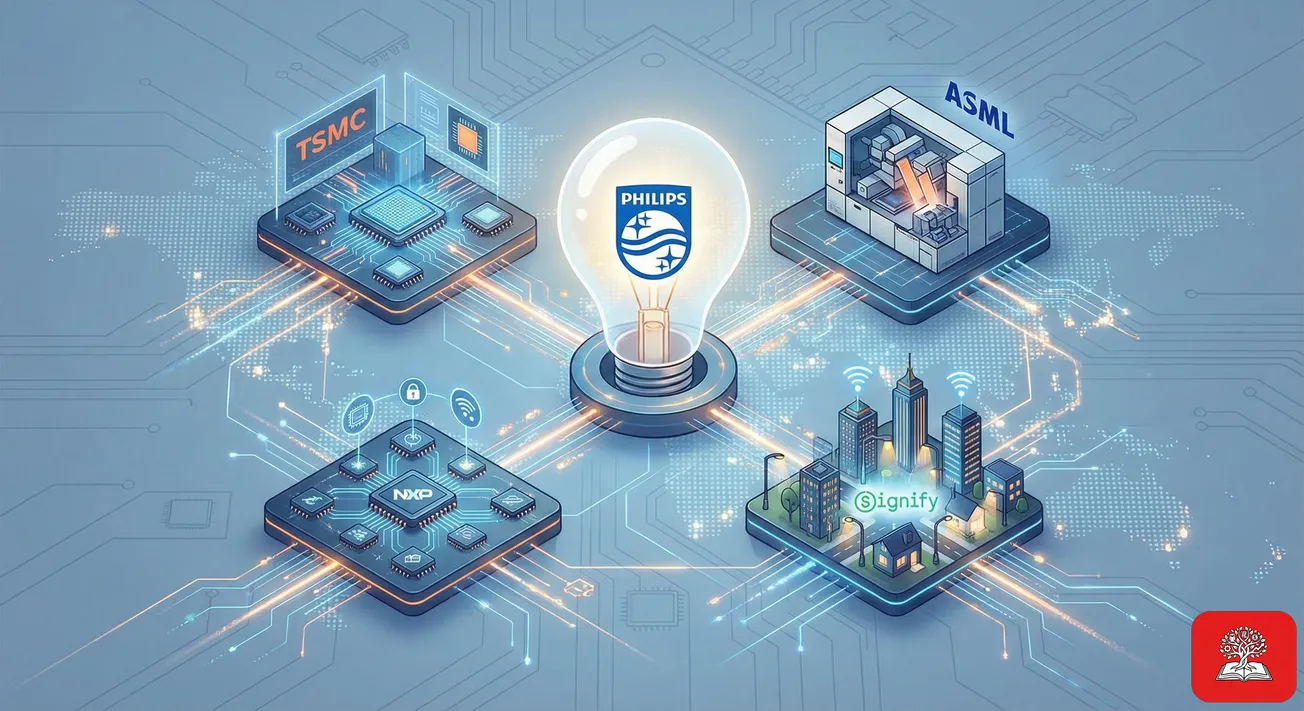
In the pantheon of technology giants, names like Apple, Nvidia, and Microsoft dominate the headlines. They are the architects of the digital age, the trillion-dollar titans that define our daily lives. Yet, if you were to peel back the casing of an iPhone, look inside the dashboard of a Tesla, or trace the supply chain of the world’s most advanced microchips, you would eventually find yourself staring at the DNA of a single, often underestimated company: Royal Philips.
For much of the 20th century, Philips was a consumer electronics colossus, a household name synonymous with lightbulbs, radios, and televisions. Today, to the casual observer, it appears to be a shadow of its former self—a company that has "retreated" into the specialized field of medical technology, having sold off its audio, video, lighting, and semiconductor divisions.
But this narrative of retreat is an optical illusion. Philips did not simply shrink; it underwent a form of corporate mitosis on a grand scale. By spinning off its most ambitious internal projects, Philips didn't just survive; it seeded the entire global technology ecosystem. The company effectively dismantled itself to build the infrastructure of the 21st century.
Today, the "children" of Philips—TSMC, ASML, NXP, and Signify—are collectively worth trillions of dollars. They control the checkpoints of the global economy. This is the story of how a Dutch lightbulb manufacturer became the accidental mother of the modern tech world.
Part I: The Taiwan Connection and the Birth of TSMC
To understand the sheer scale of Philips’ hidden influence, one must look east to Taiwan. Today, Taiwan Semiconductor Manufacturing Company (TSMC) is arguably the most important company on Earth. It manufactures the chips that power everything from American fighter jets to the phone in your pocket. It is a technological marvel.
However, TSMC’s existence was not inevitable. In the mid-1980s, the semiconductor industry was vertically integrated. If you designed chips, you built them yourself. There were no "foundries"—factories that simply built chips for others. Morris Chang, a veteran of Texas Instruments, had a radical idea to change this, but he needed capital and, more importantly, intellectual property (IP).
Chang pitched his idea to the American giants. Intel said no. Texas Instruments said no. They saw no value in a contract manufacturer.
But Philips said yes.
In 1987, Philips took a massive gamble. The Dutch company put up $58 million and their entire portfolio of semiconductor manufacturing IP in exchange for a 27.5% stake in the newly formed TSMC. It was a joint venture with the Taiwanese government, but it was Philips’ production technology that allowed TSMC to hit the ground running.
For decades, Philips remained the largest external shareholder in TSMC. It was a symbiotic relationship: Philips got a guaranteed supply of chips for its consumer electronics, and TSMC got a steady partner that transferred critical knowledge on how to run a wafer fab.
The return on this investment is staggering to contemplate. Philips slowly sold down its stake in TSMC between 1997 and 2008 to fund its own restructuring. In total, Philips realized a return of roughly 300 times its initial investment. But the financial windfall pales in comparison to the strategic impact. By backing Morris Chang when the Silicon Valley establishment turned its back, Philips facilitated the "fabless" revolution. Companies like Nvidia, Qualcomm, and Apple could not exist in their current form without TSMC. Philips didn't just invest in a company; they invested in a new industrial model that unlocked the digital age.
Today, while Philips no longer owns a share of TSMC, the Taiwanese giant still operates with a rigor and precision that can trace a faint lineage back to the production lines of Eindhoven.
Part II: The Lithography Monolith – ASML
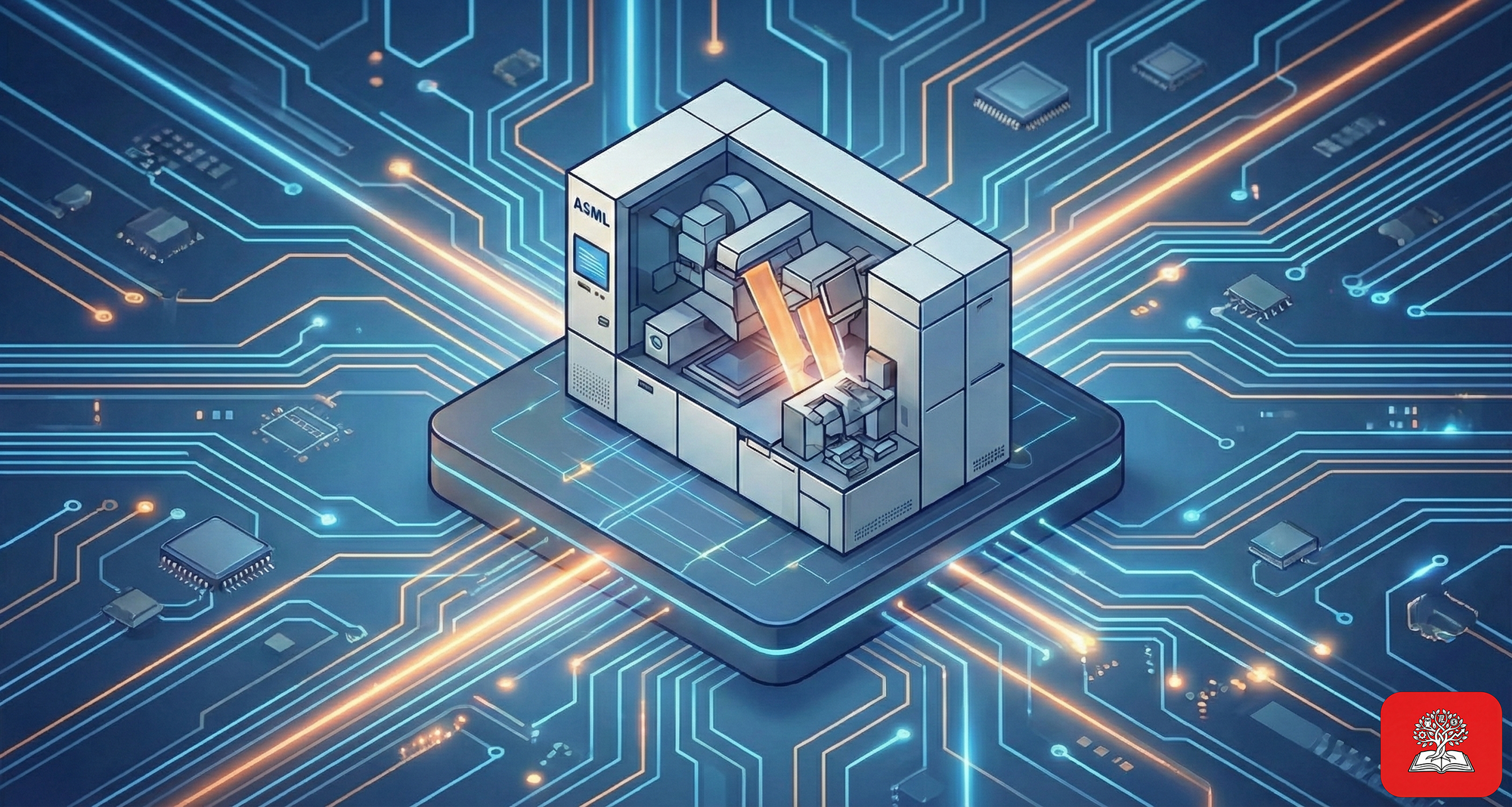
If TSMC is the engine of the modern world, ASML is the only machine that can build the engine. Based in Veldhoven, just a few kilometers from Philips’ original headquarters, ASML creates the Extreme Ultraviolet (EUV) lithography machines—bus-sized devices costing approximately $350 million each—that are required to print the most advanced microchips. ASML has a 100% market share in this critical technology.
ASML is not just a spin-off; it is a child that Philips raised through a very sickly childhood.
In the early 1980s, the race to shrink transistors was heating up. Philips researchers at the famous NatLab (Natuurkundig Laboratorium) had developed a prototype lithography machine called the PAS 2000. It was promising, but Philips, struggling with Japanese competition in consumer electronics, lacked the funds to commercialize it alone. They looked for a partner and found ASM International. In 1984, the joint venture "ASM Lithography" was born.
The early years were disastrous. The company was housed in a leaky shed next to a Philips office. During rainstorms, engineers had to cover the multi-million dollar prototypes with tarps to prevent short circuits. The company lost money hand over fist. By 1988, ASM International wanted out, unable to sustain the losses.
Philips could have killed the project. The economic rationale was to shut it down. Instead, Philips doubled down, buying out its partner and carrying the financial burden of ASML alone for several more years. They believed in the fundamental physics of their machine.
It wasn't until the mid-1990s that ASML went public, and Philips began to divest. But the crucial transfer had already happened: Philips had transferred not just patents, but a culture of "high-precision engineering" and a network of suppliers that allowed ASML to eventually overtake giants like Nikon and Canon.
Today, ASML is Europe’s most valuable technology company, worth significantly more than Philips itself. It is the sole gatekeeper of Moore’s Law. Without the patience of Philips’ board in the late 1980s—keeping the lights on in that leaky shed—the progress of artificial intelligence and mobile computing would likely be decades behind where it is today.
Part III: The Silicon Powerhouse – NXP
While ASML builds the machines and TSMC runs the factories, the actual design of chips was also a Philips stronghold. For decades, "Philips Semiconductors" was a top-10 global chipmaker, inventing technologies that became industry standards, such as I²C (Inter-Integrated Circuit), a communication protocol still used in almost every electronic device today to let chips talk to each other.
By 2006, however, the volatility of the chip market was clashing with Philips’ desire for stable, healthcare-driven growth. Philips made the decision to divest. Philips sold an 80.1% stake in its semiconductor division to a consortium of private equity firms.
The new company needed a name. They chose NXP, standing for the "Next Experience."
Divorced from the slow-moving bureaucracy of a conglomerate, NXP flourished. It refocused its strategy away from generic consumer chips and toward high-complexity, high-reliability sectors—specifically, the automotive industry.
Today, NXP is a titan in its own right. It is one of the world's largest suppliers of automotive semiconductors. If you drive a modern car, NXP is likely controlling the infotainment, the secure entry (keyless fob), the battery management system, and the in-vehicle networking.
The spin-off allowed NXP to acquire Freescale (formerly Motorola’s chip division) in 2015, a merger that created a western chip giant capable of rivaling Texas Instruments. While Philips no longer owns NXP, the company’s headquarters remains on the High Tech Campus in Eindhoven, occupying the very buildings where Philips engineers once worked. The "Nijmegen" fab, a crown jewel of Dutch manufacturing, is an NXP facility that traces its roots directly back to Philips’ early transistor experiments in the 1950s.
NXP represents the operational legacy of Philips: the pragmatic, engineering-first culture that builds the "boring" but essential chips that keep the physical world running.
Part IV: The First Love – Signify
For over 120 years, Philips was lighting. The company was founded in 1891 by Gerard and Anton Philips specifically to manufacture incandescent lamps. Lighting was not just a business unit; it was the soul of the corporation. The decision to spin it off in 2016 was an emotional amputation, akin to Ford deciding to stop making cars.
The logic, however, was sound. The lighting industry was undergoing a violent disruption, shifting from analog lightbulbs (a replacement market) to digital LEDs (a technology market). Philips realized that to survive, the lighting business needed the agility of a tech company, not the baggage of a healthcare conglomerate.
The result was "Philips Lighting," later rebranded as Signify.
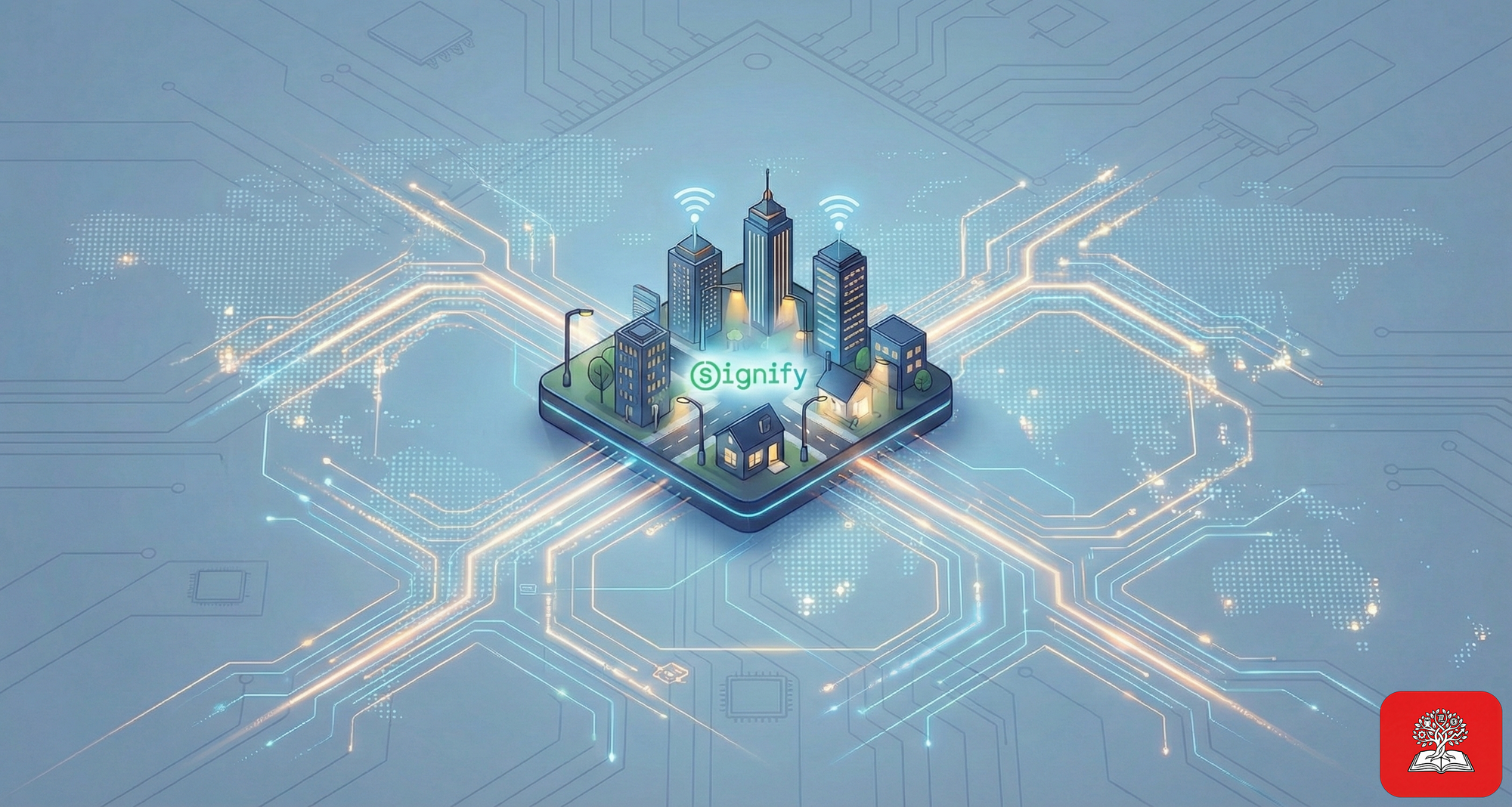
Signify is now the world leader in lighting, but it is a very different beast from the lightbulb maker of old. It is an Internet of Things (IoT) powerhouse. Through its Philips Hue brand, it created the smart home lighting category. Through its Interact IoT platform, it manages street lighting for entire smart cities, turning lamp posts into data nodes that monitor traffic and air quality.
By spinning off Signify, Philips allowed the lighting division to aggressively pursue acquisitions and R&D in connectivity without fighting for budget against MRI machines and electric shavers. Signify remains the custodian of the Philips brand for lighting products, maintaining the heritage while aggressively modernizing the technology. They have pioneered "Li-Fi" (internet through light waves) and horticultural lighting that allows vertical farms to grow food without sunlight—innovations that originated in Philips research labs but are now commercialized by Signify.
Part V: The Ecosystem – Brainport and the High Tech Campus
Perhaps the biggest thing Philips built isn't a company, but a place.
In the late 1990s, Philips made a decision that was unprecedented for a secretive tech giant. It decided to move its R&D headquarters, the NatLab, to a new location in Eindhoven. But instead of building a fortress with high walls, they built the High Tech Campus Eindhoven—and they opened the gates.
Philips invited other companies to set up shop on the campus. They introduced the concept of "Open Innovation," the idea that in a world of complex technology, no single company can invent everything alone.
When Philips moved its global headquarters to Amsterdam in a symbolic shift toward healthcare, it left behind an ecosystem in Eindhoven known as Brainport. This region is now often cited as the "smartest square kilometer in Europe."
The Brainport region is a unique economic engine. It is where ASML, NXP, Signify, and Thermo Fisher Scientific (formerly Philips Electron Optics) coexist. Because they all share a common ancestry in Philips, there is a shared culture of collaboration. Engineers move between these companies; suppliers serve all of them.
This ecosystem is Philips’ most enduring legacy. By collapsing its own vertical integration, Philips fertilized the soil for a horizontal supply chain that is the envy of Europe. The "Eindhoven model" helped the Netherlands avoid the Rust Belt fate of other industrial hubs. Instead of empty factories, Eindhoven has one of the highest patent densities in the world, directly driven by the companies Philips spawned.
Part VI: The Optical Legacy and the "Philips Paradox"
No article on Philips’ legacy is complete without a nod to the Compact Disc (CD), the DVD, and the Blu-ray. Developed in partnership with Sony, these optical formats defined media consumption for three decades. While streaming has largely replaced physical media, the technologies Philips developed for optical storage—lasers, precision coding, and error correction—found new life in telecommunications and data storage.
This brings us to the "Philips Paradox."
Business schools often study Philips as a cautionary tale of a company that invented everything but commercialized nothing. They invented the cassette tape, the CD, the VCR (V2000), and key components of the microchip, yet they often lost the market wars to Japanese or American rivals.
However, viewing this as a failure misses the bigger picture. Philips was never just a company; it was a research institute with a P&L statement. Its "failure" to keep everything in-house was actually a triumph for the world. If Philips had jealously guarded its lithography tech, ASML might have died in that leaky shed, and Moore's Law would have stalled. If they hadn't backed TSMC, the fabless revolution might never have started.
Philips operated with a distinctive form of "stakeholder capitalism" long before the term was trendy. They prioritized the continuity of the technology and the employment of their workforce over the maximization of short-term quarterly profits. The divestments of ASML, NXP, and TSMC were managed exits that ensured these companies would thrive independently, rather than being sold for scrap.
Conclusion: The Invisible Architect
Today, Royal Philips is a focused HealthTech leader. It makes ultrasound machines, sleep apnea devices, and AI-driven diagnostic tools. It is a successful, important company in its own right.
But its shadow is vastly larger than its current stock price.
When you read news about the "Chip Wars" between the US and China, you are reading a story about ASML and TSMC—two companies birthed by Philips. When you tap your credit card to pay for a coffee, the secure element chip inside is likely made by NXP—a company birthed by Philips. When you walk through a smart city illuminated by intelligent streetlights, you are walking through a grid managed by Signify—a company birthed by Philips.
We live in a world built by the technological diaspora of Eindhoven. Philips may have sold off the family silver, but in doing so, they enriched the world. They proved that sometimes, the most successful thing a giant can do is not to grow larger, but to break itself apart and let its children conquer the world.
So, the next time you hear about the titans of the semiconductor industry, remember the Dutch giant that made them possible. Philips didn't just light up the world with bulbs; it lit the spark of the digital revolution.