

Allow me to formally introduce myself to the readers of Compounding Chronicles. My name is Frank, and this project was born at the crossroads of my personal history and my professional ambitions. I view this website as a natural evolution of my heritage, as I am the son of a teacher and a business journalist.
In many ways, I am following in my parents' footsteps, merging their respective vocations into a single pursuit. From the journalistic side, I have learned the importance of skepticism, deep research, and the need to look beyond the headlines to understand the true health of an organization. From the educational side, I have inherited a drive to share knowledge, aiming not just to inform, but to deepen the overall understanding of my audience. Writing is the medium through which I can synthesize these influences, providing readers with clarity on topics often clouded by jargon and noise.
The primary mission of Compounding Chronicles is to teach individuals about the long-term ownership of high-quality businesses led by great leaders. This pursuit naturally leads us to explore timeless wisdom, as the principles that build great companies are often the same ones that build a meaningful life.
Together we will explore what makes a business truly great, why the actions of strong leaders are a critical variable, and how we can uncover the enduring truths hidden within their stories. Whether you are a seasoned investor or just starting out, this platform is designed to guide your pursuit of compounding growth in business and beyond.
Business

At Compounding Chronicles, our investment philosophy is anchored in a rigorous selection process. We do not view stocks merely as electronic blips on a screen, but rather as fractional ownership interests in real, living organizations. Consequently, our analysis begins with the fundamental health and structure of the underlying business. We are highly selective, looking for specific characteristics that separate average companies from the exceptional ones that belong in a high-quality portfolio.
First and foremost, we look for an understandable business model. This speaks to the concept of the "circle of competence." If we cannot clearly articulate how a company makes money, who its customers are, and what the unit economics look like without referencing a complex flowchart, we simply pass. We view complexity as a potential hiding place for structural risk, preferring instead the elegance and safety of a straightforward business model.
Secondly, we demand a history of profitability. We are not interested in "story stocks" or pre-revenue ventures that promise profits in the distant future. We look for a proven track record that demonstrates the business works in practice, not just in theory. This history serves as evidence of the company's resilience across different economic cycles.
Third, and perhaps most importantly, we seek a durable competitive advantage, often referred to as a "moat." Capitalism is brutally competitive; if a business earns high returns on capital, competitors will naturally try to attack those margins. A wide economic moat—whether through brand power, network effects, high switching costs, or scale advantages—protects the business from these attacks, allowing it to sustain high returns for decades.
Furthermore, we require strong management with integrity. We look for leaders who treat shareholders as partners. More on this in the next section.
Finally, we focus on strong free cash flow. While earnings can be manipulated through accounting adjustments, free cash flow is the truth-teller of business performance. We look for businesses that act as cash-generating machines, providing the fuel for future growth and compounding.
Leaders
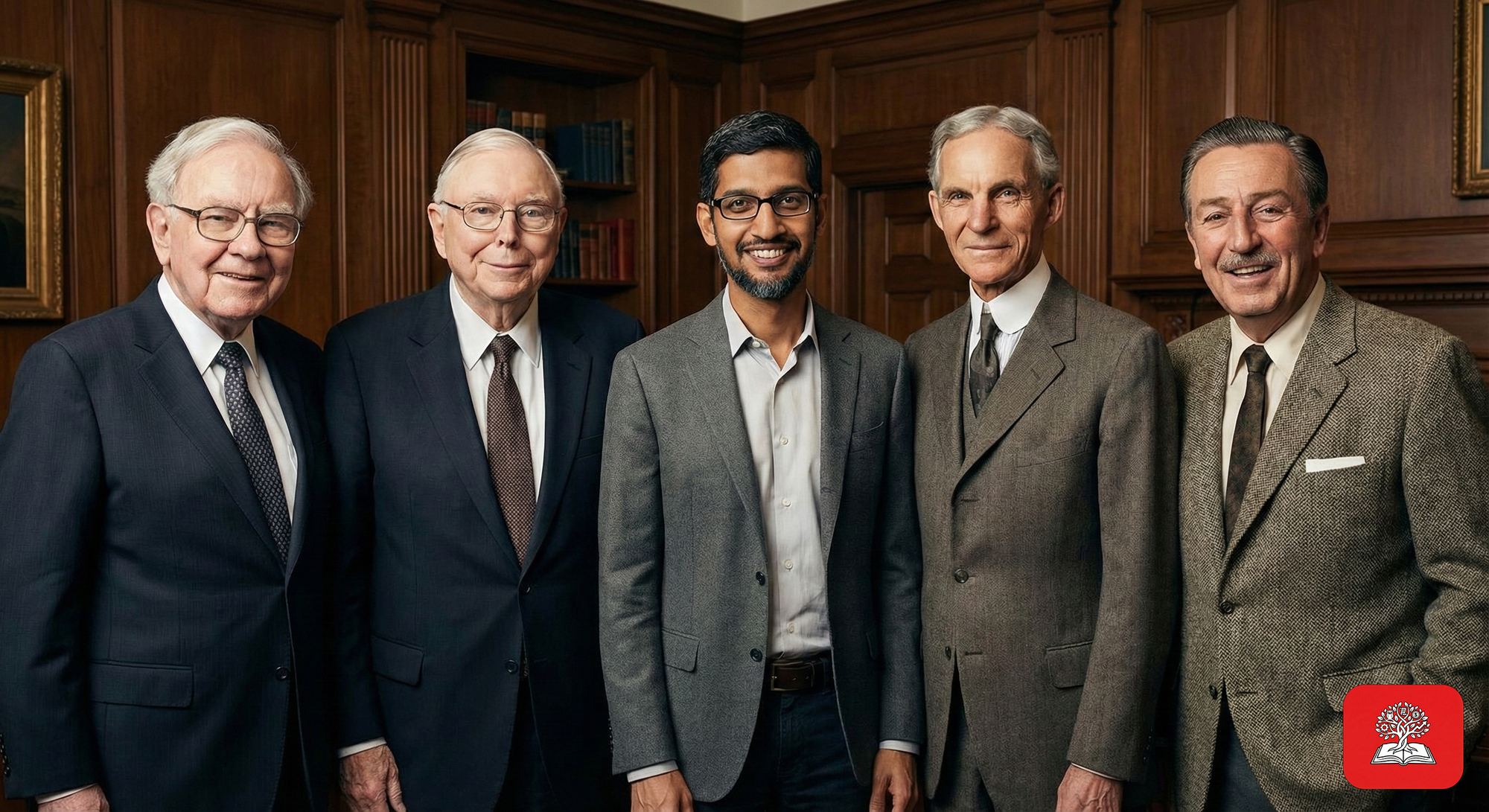
A great business model in the hands of a mediocre management team can result in a poor investment, whereas a mediocre business in the hands of a brilliant management team can sometimes be turned around. However, the "holy grail" of investing is finding a superior business run by superior leaders. At Compounding Chronicles, a significant amount of time is spent analyzing the people in the boardroom. We have a specific set of criteria for the types of leaders we want stewarding our capital.
Our first requirement is that the leaders must be master capital allocators. A CEO has two main jobs: running the operations and deciding what to do with the money those operations generate. They can reinvest in the business, acquire other companies, pay down debt, return cash to shareholders via dividends, or buy back stock. The long-term returns of a stock are largely determined by how effectively a CEO pulls these levers. We look for leaders who treat every dollar of retained earnings with reverence and deploy it only where it will generate the highest return on investment.
We also demand "skin in the game." We want management teams that are significant shareholders themselves. When a CEO's personal net worth is tied to the long-term performance of the stock, their interests are naturally aligned with ours. We prefer leaders who are buying stock with their own money, rather than those who are constantly selling stock options granted to them as compensation.
Additionally, we look for a long-term vision. The modern financial world is plagued by "quarterly capitalism," where decisions are made to satisfy Wall Street's short-term earnings estimates. We seek leaders who are willing to sacrifice short-term profits to build long-term value, even if it means being misunderstood by analysts for a period.
We also highly value radical candor. Shareholder letters are read religiously, strictly looking for honesty. Does the CEO admit mistakes? Do they discuss the challenges the business faces, or is everything always "great"? Trust is the currency of leadership, and candor is how it is earned. Finally, we look for an owner-operator mentality. We prefer founders or leaders who view the company as their life's work, rather than hired guns who are simply managing a career step before moving to the next job.
Investing
Investing is often viewed as a mathematical exercise, but at Compounding Chronicles, we believe it is more than that. While understanding accounting and finance is necessary, it is not sufficient. To achieve above-average returns over a lifetime, an investor must master both the hard skills of analysis and the soft skills of emotional discipline. Our educational content is designed to help you cultivate the mindset required to navigate the volatility of the markets successfully.
Central to our philosophy is the concept of the "margin of safety." This is the engineering equivalent of building a bridge capable of holding a 30,000-pound truck but only allowing 10,000-pound trucks to cross it. In investing, this means buying a stock at a price significantly below its calculated intrinsic value. This discount protects the investor from analytical errors, unforeseen bad luck, or economic downturns.
We also emphasize the virtue of patience. In a world addicted to instant gratification, patience is a superpower. Compounding works slowly at first, and then suddenly. The most successful investors are often those who have the ability to do nothing for long periods, allowing their thesis to play out and their companies to grow.
A critical distinction we teach is that price does not equal value. Stock prices fluctuate wildly based on the mood of the market—swinging between fear and greed—while the actual value of a business changes much more slowly. Readers are taught to view market volatility as an opportunity to serve them, rather than a threat to fear.
Furthermore, successful investing requires ignoring the noise. The 24-hour financial news cycle is designed to capture attention, not to make you wealthy. It often encourages panic and short-term thinking. A key focus is teaching the skill of filtering out the signal from the noise. Finally, we champion independent thinking. To beat the market, you must do something different from the market. This requires the courage to be a contrarian and the conviction to stand by your analysis even when the crowd disagrees.
Wisdom
While the primary focus of Compounding Chronicles is financial investment, we believe that the principles of sound investing are linked to the principles of a well-lived life. In this section, we aim to extract timeless wisdom from our study of businesses, leaders, and investing mechanics, applying these lessons to a broader context. We view investing not as a siloed activity, but as a multidisciplinary pursuit that draws upon psychology, history, philosophy, and science.
When we study great businesses, we learn about resilience, adaptability, and the importance of building a strong foundation. When we study great leaders, we learn about integrity, vision, and the art of human relationships. When we study the mechanics of investing, we learn about probability, risk management, and the delayed gratification required to build something of lasting value. This section is dedicated to synthesizing these diverse lessons into a coherent philosophy that can help you make better decisions in all areas of life.
We explore the concept of "mental models"—frameworks for thinking that help us understand how the world works. For example, the concept of "compounding" applies to knowledge and relationships just as much as it applies to money. Small consistent improvements in your skills or your health compound over time to create extraordinary results. Similarly, the "margin of safety" is a wise approach to career planning and personal risk management, ensuring you have a buffer against life's inevitable setbacks.
We also delve into the psychology of bias. Understanding the cognitive traps that lead investors to lose money—such as confirmation bias, loss aversion, and herd mentality—can also help you avoid making poor choices in your personal and professional life. By becoming aware of how our brains are wired, we can implement systems to think more clearly and rationally.
Ultimately, this section serves as the philosophical core of the website. We believe that becoming a better investor makes you a wiser person, and becoming a wiser person makes you a better investor. Our goal is to curate a collection of insights that will remain relevant regardless of what the stock market does, providing you with a reservoir of wisdom to draw upon for years to come.